Last updated August 2026
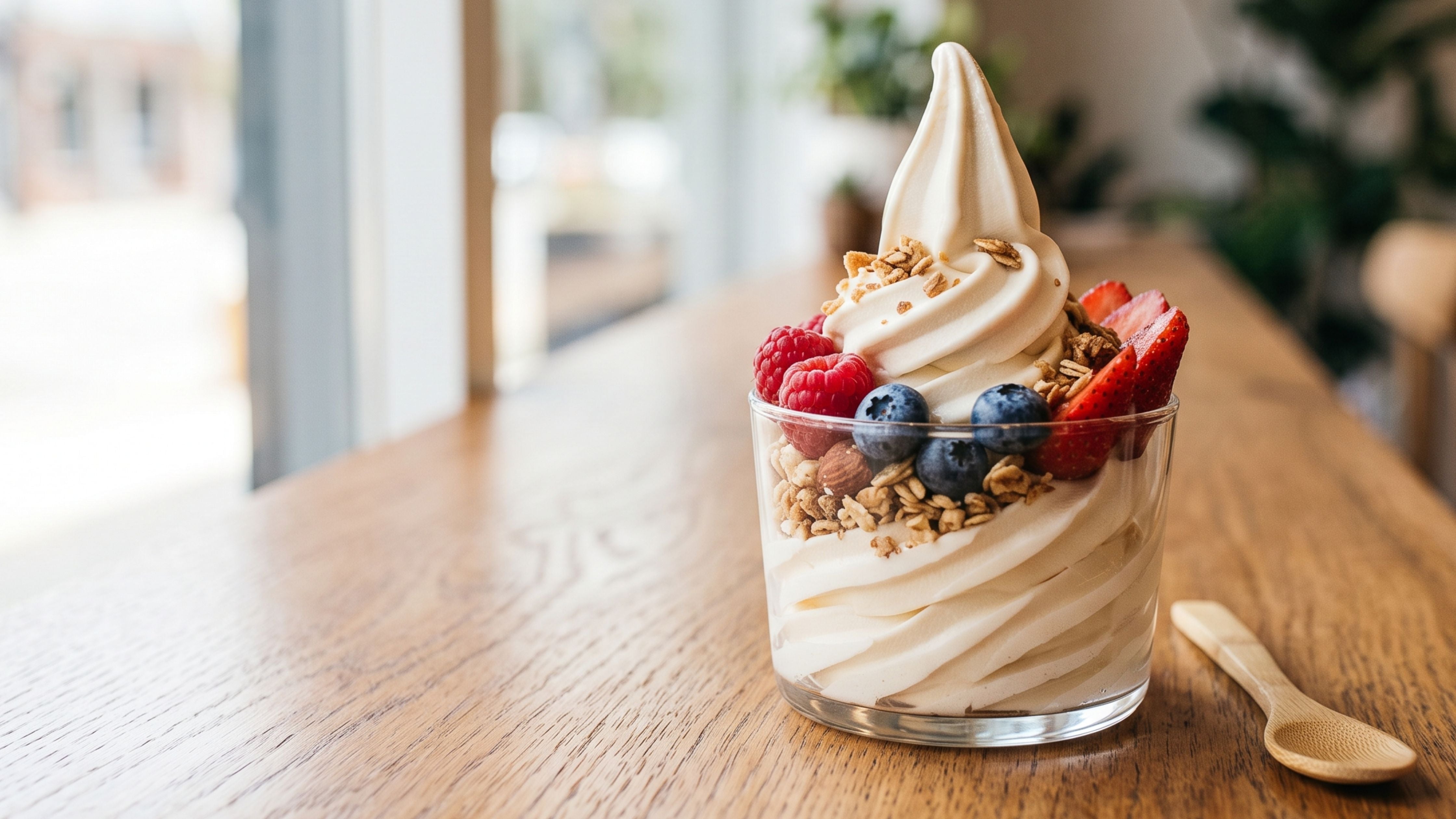
In June, a New York Times writer stood behind 74 people waiting to get into a frozen yogurt shop in Manhattan. Not a concert. Not a restaurant opening. Frozen yogurt. At the trendiest shops, a cup can run as high as $30.
If you own a dessert shop, a café, a boba bar, or a restaurant with a tired dessert menu, you have probably noticed something smaller but similar in your own market. More people asking. More competitors putting a machine in.
Here is what is actually driving the 2026 frozen yogurt trend, what is different from the froyo bubble that burst a decade ago, and what a working operator should do about it.
The short version:
- Frozen yogurt servings rose 26% year over year, and froyo chains are beating ice cream shops on foot traffic nearly every week of 2026.
- The driver is protein, not nostalgia — a more durable health claim than the low-fat pitch that collapsed in the 2010s.
- This cycle’s growth is coming from cafés, boba bars, and restaurants adding a froyo line, not from thousands of new standalone shops.
- For most operators, that means one machine, light fixed costs, and aggressive flavor rotation — not a buildout.
The frozen yogurt numbers are real — and they are not just a New York story
Three independent data sets point the same direction.
Servings are up sharply. Circana counted a 26% increase in frozen yogurt servings sold in the 12 months ending March 2026.
Foot traffic is beating ice cream, week after week. Location-analytics firm Placer.ai found that visits to frozen yogurt chains grew year over year in nearly every week of the first half of 2026, at times topping 18%. Traditional ice cream shops went the other way over the same stretch, falling as much as 8.5% below the prior year in some weeks. That gap matters. Froyo is not just floating on a rising dessert tide — it is taking share.
Search demand is at a record. Yelp trend expert Tara Lewis told Restaurant Business that searches for soft serve hit an all-time high in June, with black sesame soft serve alone up 89% year over year.
And the franchise money is moving. 16 Handles signed 25 new franchise agreements in the first half of 2026 — more than it signed in all of 2025 — while posting 30% same-store sales growth on top of 20% growth the year before.
Why frozen yogurt is trending again in 2026
Three things are happening at once. Only one of them is nostalgia.
1. Protein replaced “low fat” as the health story
This is the big one, and it is the reason the current boom has better bones than the last one.
The 1980s froyo wave sold the absence of something: fat. The 2010s wave sold a softer version of the same idea: fewer calories than ice cream. Both claims were fragile, and both were quietly destroyed by the topping bar.
The 2026 wave sells the presence of something. Protein. In the International Food Information Council’s July 2025 protein survey, 70% of Americans said they were actively seeking out protein foods, and high-protein was the most common diet of the year. Layer GLP-1 medications on top of that: Mintel found that U.S. households using GLP-1s eat yogurt at roughly three times the average rate, because they are eating less and need every bite to do more work.
A customer who eats one dessert a week instead of four is a customer who will pay more for that one dessert. That is a better customer than the 2012 froyo customer, not a worse one.
2. Froyo became an outing, not an impulse buy
The Placer.ai data has a detail most coverage skipped: Friday and Saturday together account for about 36% of weekly visits to frozen yogurt chains, a heavier weekend skew than ice cream shops see. People are planning to go. It behaves less like a gas-station stop and more like a coffee run with friends.
That has real operational consequences, and we will come back to them.
3. The product is built for social media
Customization, color, a topping wall, and a cup you assemble yourself. Froyo was engineered for photos before photos were the point. The new premium shops lean all the way in — imported Greek yogurt, olive oil and crumbled baklava as toppings, Alphonso mangoes. 16 Handles has run limited flavors like French Fry, Butter Beer, and Keto Chocolate Brownie specifically to get people posting.
But didn’t we already watch this collapse once?
Yes. And any operator who lived through it is right to be skeptical.
Restaurant Business editor Jonathan Maze has described the last froyo run as among the strangest bubbles the restaurant industry has produced. Between 2011 and 2014, brands multiplied until you could not walk the National Restaurant Association Show floor without tripping over a froyo machine. Pinkberry peaked at 154 locations in 2014 and was sold to a brand holding company the following year. Maze’s diagnosis was blunt: the business grew too fast, with too many brands that were entirely too similar, and they cannibalized each other until the math stopped working.
That is the honest risk, and it has not gone away. Dessert concepts sit on no floor of habitual demand. Nobody needs froyo on a Tuesday.
What is genuinely different this time
Two things.
The health claim is more durable. “Contains protein” survives a topping bar in a way “is low fat” never did. A customer who adds granola and fruit to a protein-forward base has not contradicted your marketing. In 2012, a customer who buried tart yogurt under cheesecake bites and gummy bears had.
Growth is coming from menu additions, not just from new shops. This is the part that separates 2026 from 2013. In the last cycle, the growth vehicle was the standalone froyo store — thousands of nearly identical strip-mall units with the same fixed costs and the same customer. This time, cafés, bakeries, bubble tea stores, and bars are adding frozen dessert to menus they already have, using staff and counter space they already pay for.
That is a structurally safer way to enter a trend, and it is the model most readers of this article should be using.
How to add frozen yogurt to your menu: six practical takeaways
1. Add a froyo line. Don’t build a froyo shop.
Unless you are a multi-unit operator with real site-selection capability, the standalone froyo store is the expensive way to play this. A single soft serve machine bolted onto an existing business gets you most of the upside with a fraction of the fixed cost — no new lease, no new payroll, no new customer acquisition problem.
For context on what a strong dedicated concept can do: 16 Handles reports an average unit volume of $983,903 for the top half of its stores, with gross margin around 74% after food costs, per its franchise disclosure document. Read that carefully — it is the top 50% of a well-run, well-located franchise system, which is not a forecast for your store. But the margin figure is the useful part. Frozen dessert is a high-gross-margin item almost everywhere it is sold well.
2. Staff and market for Friday and Saturday
If roughly a third of category traffic lands on two days, then your froyo revenue is a weekend-evening business wearing a seven-day costume. Schedule for it. Promote for it. And if you close at 6 p.m., you are shut for the exact hours the category is growing.
3. Sell flavor and protein. Stop selling “guilt-free.”
The diet framing is what killed the last wave’s credibility. Time Out’s roundup of the leading new shops found they had traded diet-culture positioning for open indulgence, competing on richness and ingredient quality instead of on what they had removed. Put the tart, the tang, and the ingredients on your menu board. Let the nutrition speak for itself in the small print.
4. Treat flavor rotation as a marketing budget line
Black sesame up 89% in Yelp searches. Limited-run flavors earning 16 Handles national press coverage. Flavor rotation is no longer a menu decision — it is your cheapest customer acquisition channel. A shop that runs the same four flavors all year is paying for ads to do what a rotating fifth tap would do for free.
The practical constraint is that most operators cannot rotate, because rotation means carrying inventory you are not currently selling. Which brings us to the boring part that actually decides whether this works.
5. Keep your downside small
The single biggest mistake of the last cycle was operators taking on fixed costs sized for the peak. Long leases, big buildouts, deep inventory commitments. When traffic softened, the costs did not.
Build this so a slow quarter is survivable. That means renting or financing equipment before buying it outright, avoiding a dedicated buildout you cannot repurpose, and — critically — not tying up cash and cold storage in perishable inventory that is only worth anything if the trend holds.
6. Don’t chase the $30 cup
The $30 cup exists in a handful of big-city shops with imported Greek yogurt and a line around the block. It is not a price point, it is a press story. Price to your market, and win on rotation and consistency instead.
The inventory question nobody asks until it hurts
Every soft serve machine runs on one of two mix formats, and the choice quietly determines how much risk you are carrying.
Equipment manufacturer Taylor lays out the tradeoff plainly: liquid mix goes straight into the machine but requires refrigeration and has a shorter shelf life, while powder mix is shelf-stable until it is reconstituted, which helps operations with limited refrigerated storage or infrequent deliveries. Taylor is equally honest about the catch: powder adds a preparation step and requires accurate measuring, so you need a repeatable process.
For an operator adding froyo to an existing menu, that tradeoff is usually lopsided. Liquid mix means dedicating freezer or cooler space you probably do not have, on a delivery schedule you do not control, for a product line that is still unproven in your store. Powder means a box on a dry shelf and a few minutes of prep.
This is the problem YPF was built to solve. Our wholesale frozen yogurt powder mixes have a two-year shelf life at room temperature and need no cold chain at all. Each 2kg (4.4 lb) bag yields up to 10 liters (2.65 gallons) — roughly 50 servings — from powder, water, and milk. And every one of our 50+ flavors uses the exact same preparation method, which is what makes real flavor rotation possible: you are not learning a new recipe to test Taro or Matcha for a month, you are opening a different bag.
If you need dairy-free on the menu, our vegan soft serve powders run the same way.
One honest caveat before you buy a machine
Frozen yogurt is still a trend-driven category, and inexpensive treats often do well precisely when consumers are trading down from bigger purchases. That is not a reason to sit this out. It is a reason to enter in a way that does not require the trend to last five years to pay back.
The operators who got hurt last time were not the ones who sold froyo. They were the ones who bet the whole business on it. Add the line, keep the fixed costs light, rotate flavors aggressively, and let the category prove itself on your P&L before you scale it.
Frequently asked questions
Is frozen yogurt profitable in 2026?
Frozen dessert carries high gross margins relative to most menu items — 16 Handles discloses gross margin of roughly 74% after food costs in its franchise disclosure document. Whether it is profitable for you depends almost entirely on fixed costs: equipment, space, labor, and inventory carrying cost. Adding froyo to an existing operation has a far shorter payback than opening a standalone shop.
Do I need a special machine for frozen yogurt?
Any commercial soft serve machine will work. We recommend units with agitators in the hopper to keep product moving. Frozen yogurt machines are typically tuned for lower-fat, tangier mixes, but a standard soft serve unit handles our mixes fine. Contact us if you want help matching a machine to your volume.
How much frozen yogurt does one bag of powder make?
A single 2kg (4.4 lb) bag yields up to 10 liters (2.65 gallons) of finished product, or about 50 servings. You add 3.2 liters of water and 4.0 liters of milk. No separate flavor syrups, no measuring beyond that.
How long does frozen yogurt powder mix last?
Two years unopened at room temperature, out of direct sunlight. Once mixed with milk and water, plan on about 72 hours refrigerated, depending on the milk you use.
Should I use powder or liquid frozen yogurt mix?
Liquid is simpler at the point of use but requires refrigerated storage, reliable delivery, and gives you a short window to sell through. Powder is shelf-stable, ships anywhere, and lets you carry more flavors without more cold storage, at the cost of a short prep step. If you are adding froyo to an existing menu or running multiple flavors, powder is usually the lower-risk choice.
Can I offer dairy-free or vegan frozen yogurt?
Yes. YPF makes vegan soft serve powder bases in flavors including Vanilla, Chocolate, Coconut, Taro, Green Tea, and Pistachio, prepared the same way as our dairy mixes.
Where to start
If you are testing froyo for the first time, start with two or three flavors, not ten. A tart base plus one crowd-pleaser plus one conversation starter covers most markets. Our best sellers are the safest place to begin, and you can buy single bags to test before committing to a case.
Questions about volumes, machines, or wholesale pricing? Get in touch — we have been supplying froyo shops, boba bars, and soft serve operators for over a decade, and we would rather help you size this correctly than sell you inventory you cannot move.